Data · 29 October 2026
How small is the bird?
Bird photographers say they never have enough lens. I wanted a number for it, so I ran BirdFrame over 1,995 public-domain bird photos from iNaturalist and measured every bird it found: 4,511 in all.
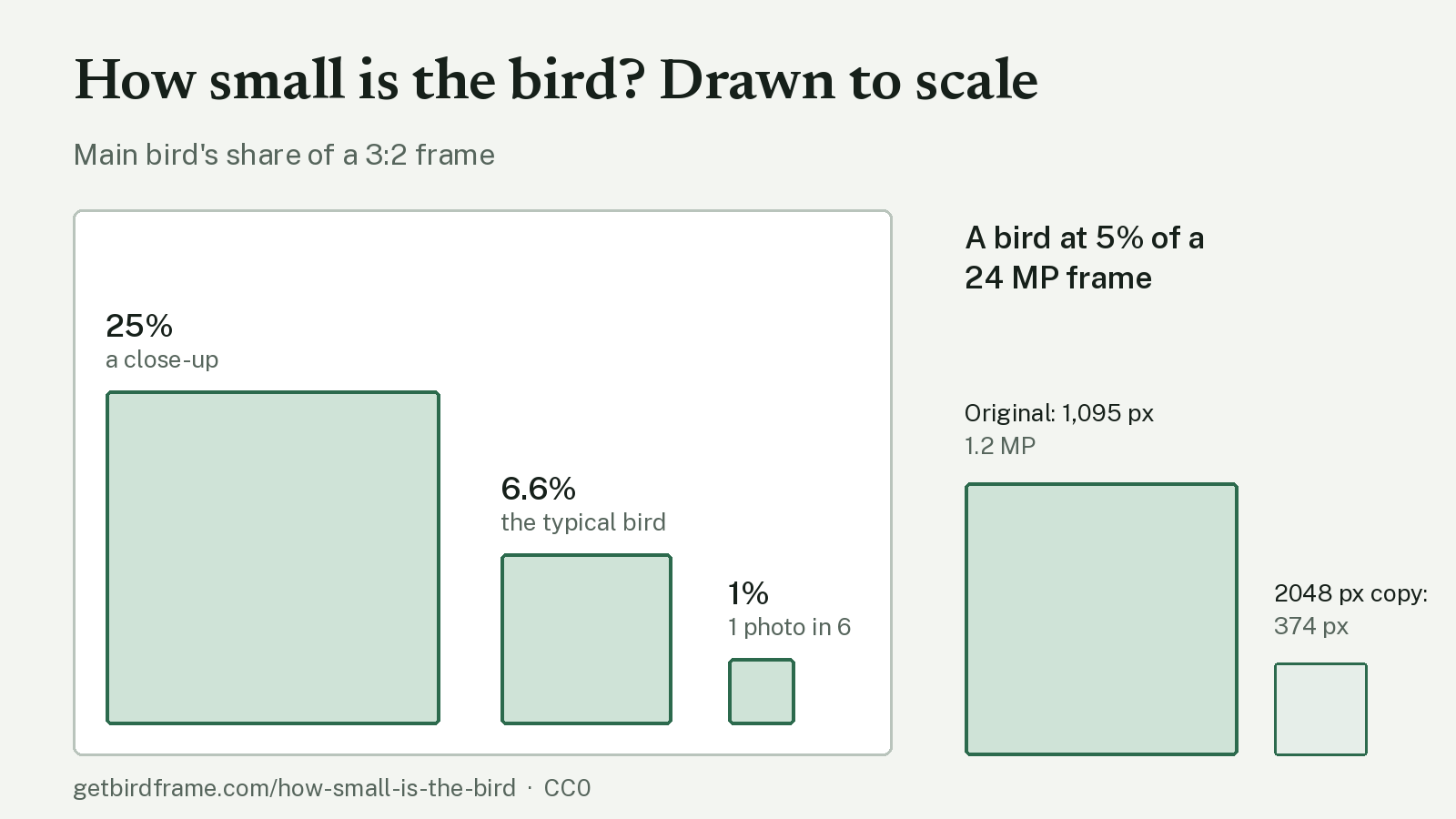
The typical bird fills 6.6% of the frame
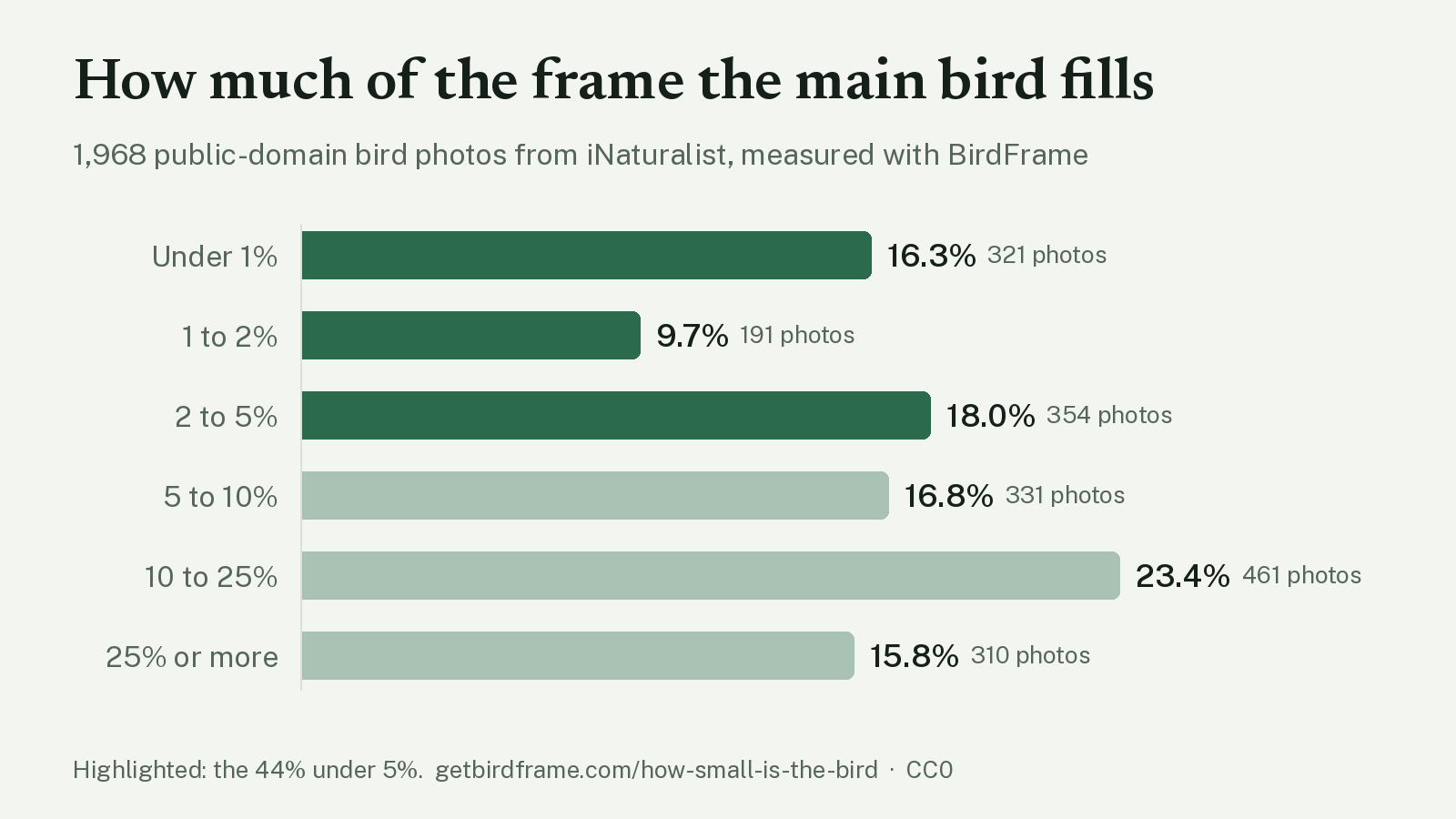
For each photo I took the main bird, the largest one found in it, and measured how much of the frame it covers. In half the photos it's under 6.6%. A quarter are under 1.9%, and only a quarter are over 17%.
Table view
| Main bird fills | Photos | Share |
|---|---|---|
| Under 1% | 321 | 16.3% |
| 1 to 2% | 191 | 9.7% |
| 2 to 5% | 354 | 18.0% |
| 5 to 10% | 331 | 16.8% |
| 10 to 25% | 461 | 23.4% |
| 25% or more | 310 | 15.8% |
What that looks like
Here are those sizes drawn to scale in a 3:2 frame, the shape most cameras shoot.
Which birds are smallest in the frame
Among the 43 species with 8 or more photos, these had the smallest main bird. It isn't about body size: swans, geese, vultures and pelicans are near the top, probably because they're photographed far off, on water or in the sky. The birds that fill the frame are the ones that come close. To see how big a bird will be with your own camera, lens and distance, try the bird reach calculator.
| Smallest in the frame | Photos | Median size |
|---|---|---|
| Rainbow Bee-eater | 8 | 0.36% |
| Common Murre | 10 | 0.80% |
| Common Buzzard | 11 | 0.88% |
| Common Merganser | 8 | 1.09% |
| Mute Swan | 16 | 1.44% |
| Turkey Vulture | 12 | 1.55% |
| Canada Goose | 26 | 1.56% |
| Great Spotted Woodpecker | 9 | 1.78% |
| Long-tailed Tit | 11 | 1.85% |
| American White Pelican | 8 | 1.92% |
| Largest in the frame | Photos | Median size |
|---|---|---|
| Common Yellowthroat | 9 | 39.9% |
| Painted Bunting | 8 | 34.7% |
| House Sparrow | 19 | 29.2% |
Median share of the frame per species, with Domestic Mallard counted as Mallard. Samples are small (8 to 26 photos each), so treat the order as a hint.
Why the full-size original matters
Shrink a 24-megapixel photo to 2048 pixels wide, a common size for sharing, and you keep 12% of its pixels. A bird that fills 5% of the frame goes from 1.2 megapixels to 0.14. At 1% of the frame, it goes from 490 pixels square to 167.
More than one bird
BirdFrame found more than one bird in 29.5% of the photos, and 49 in the busiest frame. These counts are rougher than the sizes above (see the method), but they're a reminder that one photo can hold several birds worth cropping.
Why I measured this
I make BirdFrame, a Mac app that finds the birds in a whole Apple Photos album or folder and crops each one Tight, Balanced or Wide. With birds this small in the frame, most photos need a crop, and one trip can mean thousands of them.
No cropping by hand: BirdFrame crops thousands of bird photos in one go. Full resolution kept: every crop comes from the full-size original, with no downscaling and nothing generated.
Crop every bird in one go, at full resolution. Free for up to 50 photos per run, then $29.99 once. Mac, macOS 15 or later.
Method
Photos. The 2,000 most recent research-grade bird observations on iNaturalist with a public-domain (CC0) photo, one photo each: 1,995 unique photos, observed between 2013 and 2026, at iNaturalist's largest size (up to 2048 pixels on the long edge).
Birds. BirdFrame 1.2 on a Mac found 4,511 birds in 1,968 photos, and none in 27. A bird's size is the area of the box around it as a share of the whole photo. The main bird is the largest one in each photo.
Checks. In a hand check of 40 random finds, 35 were birds, 2 were unclear and 3 weren't birds (a reflection, a leaf and a streaked rock). In 10 random photos with three or more finds, 70 of 72 finds were birds, and birds in big flocks were undercounted. So the main-bird figures are solid, and per-bird counts are approximate.
Caveats. These are documentation photos, and many iNaturalist users crop before they upload, so the frames straight out of a camera probably hold even smaller birds. The sample leans to recent uploads, and species samples are small.
Data
Download the CSV (1,995 rows, one per photo): the iNaturalist observation, observer, species, photo size, birds found, the main bird's share of the frame, and every bird's share. It's free to use (CC0), and so are the charts as images: size bands and drawn to scale. The photos belong to their observers, who released them as CC0.